Some titles describe an exhibition, while others function as a diagnosis. "El futur ja no és el que era" belongs to the latter category. It speaks not only of the future, but of the loss of faith in the very idea of progress. For decades, modernity upheld the promise that each generation would live better than the one before it, that knowledge would displace superstition, democracy would overcome authoritarianism, and memory would prevent the great disasters of history from being repeated. Today, we look back on that narrative with the same mixture of disbelief and melancholy with which we contemplate the ruins of an architecture built to last forever. And yet, ruins are not the end of history; they are the place where history continues to be written.
Francesc Torres’s work has always inhabited this territory. For more than five decades, his practice has rejected any linear understanding of time in favour of an archaeology of the present. His works do not address the past because it has come to an end, but precisely because it remains active. History never disappears; it changes its surface. It infiltrates political languages, images, monuments, everyday objects, and our own biographies. Each era believes it is inaugurating a new world while continuing to grapple with the same impulses inherited from those that came before. Perhaps this is why, for Torres, memory occupies not the realm of nostalgia but that of suspicion.
To remember does not mean to preserve; it means to critically reassess what we continue to accept as natural or self-evident. Contemporary democracies coexist with mechanisms of exclusion that we believed had been overcome; technological development multiplies our capacity to produce images while reducing the time we devote to questioning them; old nationalisms re-emerge disguised in new rhetoric; propaganda has replaced the great loudspeakers of the twentieth century with algorithms that are far more effective. The devices change, but the strategies barely do. History possesses an extraordinary capacity for recycling itself.
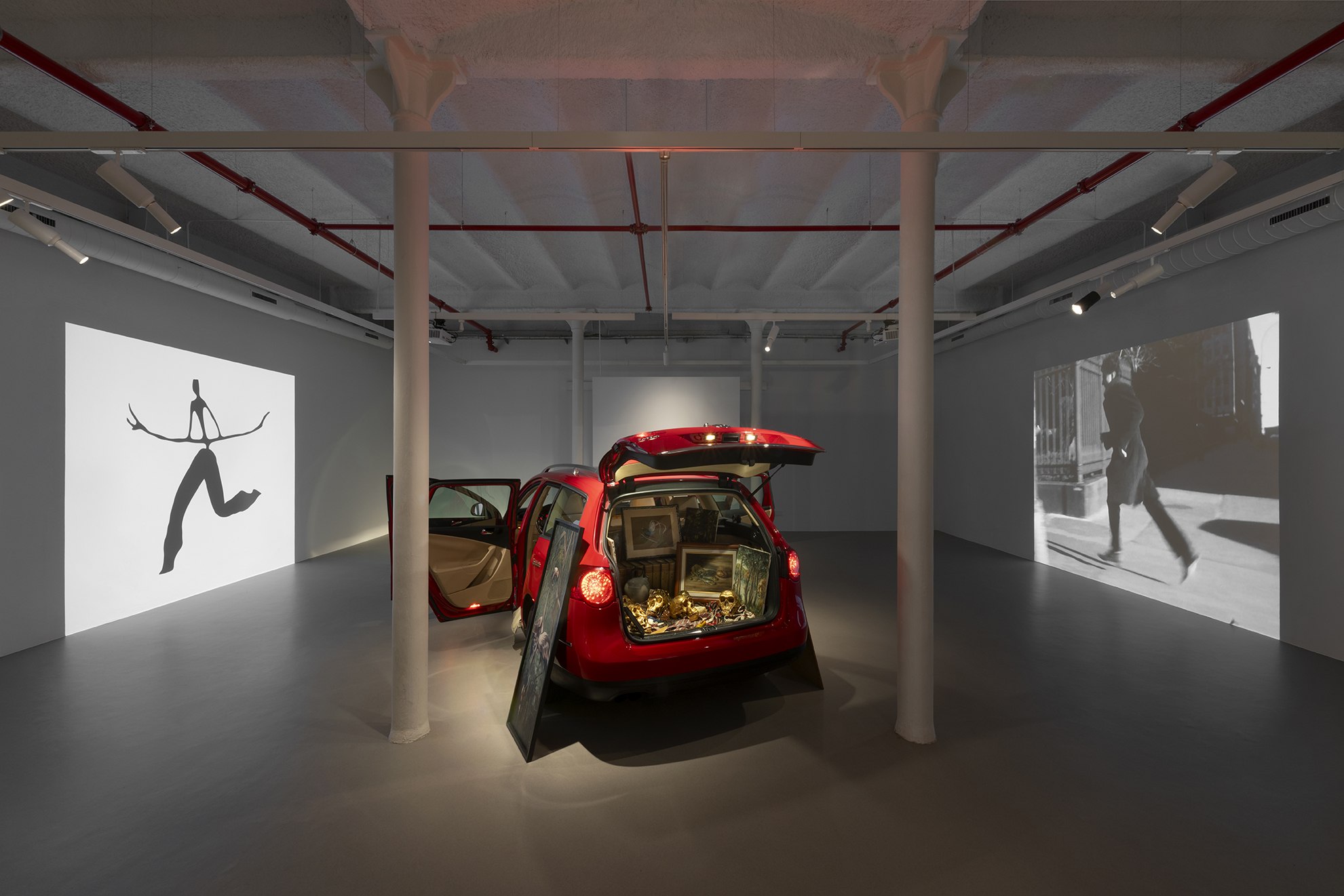
In this sense, the works brought together in "El futur ja no és el que era" do not constitute an inventory of historical events or a visual autobiography. They function as a system of relationships in which individual and collective experience cease to be separate categories. Hopper enters into dialogue with the Chinese copyists of Dafen; an aircraft of the Condor Legion flies over the uncertainties of the present; the death mask of Sitting Bull confronts contemporary capitalism; a slogan born at a demonstration against US immigration policies acquires the force of a universal rallying cry; an encyclopedic dictionary riddled with bullets bears witness to the end of one world while another has yet to fully emerge. Nothing appears in isolation because nothing exists in isolation.
Two of the exhibition’s key works are "Viatjant amb la família" and "Don’t make art unless it is absolutely necessary!". The former, "Viatjant amb la família", represents a synthesis of an entire life devoted to thinking about the world through art. Francesc Torres himself has described it as a work “that could only be made now,” and this statement is crucial to understanding it. It is not simply an autobiographical reassessment, but the moment at which individual experience acquires enough depth to become inseparable from collective history. Within this major installation converge the father as first teacher, family memory, the Spanish Civil War, dictatorship, the material culture of the post-war period, human evolution, violence, emotional education, and the artist’s own formation as a political subject. Everything is assembled as an immense archaeological stratum in which personal events cease to belong exclusively to those who experienced them and become instead a reflection on the transmission of memory and the formation of consciousness. Torres does not construct a retrospective narrative here; he turns biography into a method for interrogating history. The family invoked by the title is not only his own, but that of all those who share a common cultural and anthropological genealogy. Ultimately, the work proposes a profoundly humanist idea: understanding who we are requires accepting that every identity is the result of a long chain of inheritances, conflicts, and overlapping narratives that continue to travel with us.
For its part, "Don’t make art unless it is absolutely necessary!" encapsulates one of the essential questions running throughout Francesc Torres’s career: the legitimacy of artistic practice. The statement, formulated with the force of a moral imperative, goes beyond provocation to question the visual inflation of our time, in which producing images seems to have become an automatic gesture. Torres restores to art the gravity of something that can only justify its existence when it responds to an authentic need for knowledge. The work inevitably enters into dialogue with Duchamp, not to reiterate the comfortable reading according to which any object can be art, but precisely to dismantle the banalization that has accompanied his legacy for decades. Art is no longer understood here as a territory of institutional legitimization, but recovers its original condition: an exceptional instrument with which to confront that which we still do not know how to name. In an age dominated by the constant production of content, Torres reasserts the responsibility of producing meaning.
Francesc Torres’s artistic practice has always understood reality as a fabric of overlapping layers in which politics, anthropology, literature, science, war, humour, and personal experience form part of the same whole. Each work constitutes a possible point of entry into the narrative, but none exhausts its meaning. As with memory, meaning does not reside in any particular fragment, but in the connections we are capable of establishing between one event and another.
There is an explicit desire in this exhibition to question the great consensuses of our time. There is also a defence of intelligence in the face of simplification. At a moment when the speed at which images circulate far exceeds our capacity to interpret them, Torres insists that looking remains an intellectual activity. The work does not offer answers; it demands viewers willing to ask questions.
Perhaps this is where the true political dimension of art lies today. Not in illustrating ideologies or providing moral certainties, but in introducing complexity wherever public discourse seeks to reduce everything to easily consumable slogans. Against the spectacle that surrounds us, Torres champions doubt; against the epic of closed identities, an awareness of our hybrid condition; against the comfort of singular narratives, the uneasy coexistence of different memories.
After more than thirty-five years without presenting an exhibition at a gallery in Barcelona, Francesc Torres returns to the city where his career began. He does so after receiving the Velázquez Prize and at a time when his work has been part of the international history of contemporary art for decades. Yet far from offering a retrospective or celebratory reading, the artist returns to insist upon what he has always defended: that art does not exist to confirm our convictions, but to put them into question.
Because the future, indeed, is no longer what it used to be. Perhaps it never was. But it still depends on our ability to understand the layers of the past that continue to sustain it, in the face of the forces of emptying-out and de-education that are putting our present under strain.
José Luis Pérez Pont